 Thalla Lokesh
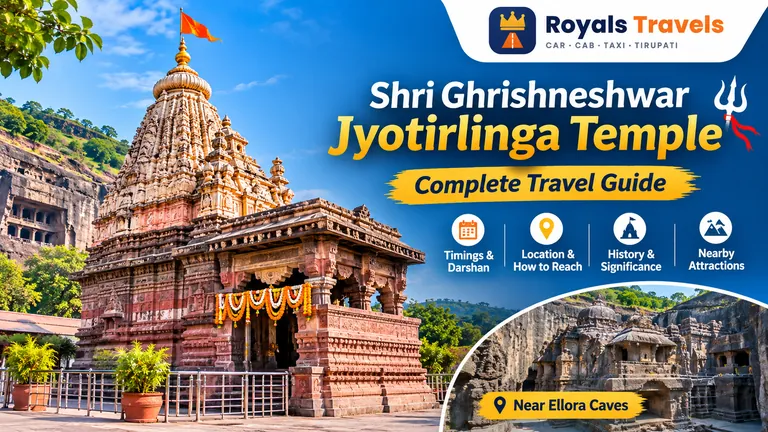
Grishneshwar Jyotirlinga is the twelfth and last of the twelve Jyotirlinga shrines of Lord Shiva, and it stands in Verul village, about 1.5–2 km from the Ellora Caves in Chhatrapati Sambhajinagar district (formerly Aurangabad), Maharashtra. Most people searching for it want one of three things: whether the temple is open today, what the darshan and aarti timings are, and how to get there. This guide answers those first, then covers the story, the architecture and the practical details. Because a large development project is currently under way around the temple, access and timings can change at short notice — so please treat the status section below as a starting point and confirm locally before you travel.
Short summary
- What it is: the twelfth and final Jyotirlinga of Lord Shiva, completing the traditional Jyotirlinga circuit.
- Where: Verul village, 1.5–2 km from the Ellora Caves, about 30 km from Chhatrapati Sambhajinagar (formerly Aurangabad), Maharashtra.
- Timings: commonly published as about 5:30 AM to 9:00–9:30 PM with three daily aarti sessions — secondary sources, not an official notice.
- Current status: development work is under way at the temple precinct. A six-month closure was reported in October 2026, then softened by the district administration. Unconfirmed as of 10 November 2026 — check before you travel.
- Dress code: modest traditional clothing; by local custom men remove their upper garment to enter the sanctum.
- Also spelled: Ghrishneshwar, Ghrneshwar, Ghushmeshwar, Grishneshwar Jyotirling — all the same shrine.
Quick visitor information
| Location | Verul (Ellora), Khuldabad taluka, Chhatrapati Sambhajinagar district, Maharashtra — about 30 km north-west of Chhatrapati Sambhajinagar city |
|---|---|
| Nearest landmark | Ellora Caves (UNESCO World Heritage Site), roughly 1.5–2 km away |
| Status checked | 10 November 2026. Development work is under way in and around the temple. Reports in October 2026 differed on whether the temple itself would close — see the status section below. We could not independently confirm the position as of this date. |
| Commonly published timings | Usually listed as around 5:30 AM to 9:00–9:30 PM, with a midday break reported by some sources. These are not from an official temple notice and vary between sources — confirm before planning. |
| Dress code | Modest traditional clothing is expected. By long-standing local custom, men remove their shirt/upper garment to enter the sanctum. |
| Before you go | Check the same day with your hotel, a local taxi operator, or the temple office at Verul. Darshan arrangements during construction can change without notice. |
Is Grishneshwar Temple Open or Closed? Latest Update
Last checked: 10 November 2026. We could not independently confirm the temple’s current darshan status from an official source on this date. Here is exactly what is on the public record, so you can judge for yourself.
A large tourism and pilgrim-infrastructure project is under way at Verul — a “cluster” development linking the Ellora Caves, the gardens and the temple precinct, tied to preparations for the Nashik Kumbh Mela. Budgets have been reported at about ₹120 crore for the temple precinct and ₹210.45 crore for the wider cluster. The plan includes a pilgrim tunnel, a long covered darshan queue, parking, a Bhakta Niwas and road widening.
Documented timeline
- 23–24 September 2026: Work began on a 75-metre underground passage beneath the Kannad–Khultabad road after Archaeological Survey of India permission. A Public Works Department deputy engineer was quoted saying it should take about two months and cut darshan waiting from 1.5–2 hours to roughly 30 minutes. (Sakal)
- 30 September – 1 October 2026: After an administration–villagers meeting in Verul, it was reported that internal work on the temple premises would likely begin on 1 November 2026, shutting the temple to devotees for about six months. (Pudhari)
- 2 October 2026: District Collector Vinay Gowda G.C. assured a delegation of shopkeepers, trust members and villagers that the temple would not be closed for the full six months, and that any closure would be kept to a minimum. (Sakal)
- 3 October 2026: An assistant engineer was quoted saying a closure would be needed because construction was taking place inside the temple premises, with renovation estimated at about six months. (ETV Bharat)
- 18 October 2026: The District Collector inspected the works and directed officials to reduce darshan waiting time. No closure was announced in that coverage. (Free Press Journal)
In short: a six-month shutdown was proposed and widely reported, then publicly softened by the district administration after local opposition. We found no confirmed announcement that a full closure began — and no official notice confirming normal darshan either.
What to do before you travel
- Call ahead the morning of your visit. Your hotel, a local cab operator at Verul or the temple office will know the position on the day.
- Plan a flexible itinerary. Pair the temple with the Ellora Caves and Daulatabad Fort so the trip still works if sanctum access is restricted.
- Allow for traffic restrictions around the approach road while the underpass is built, and expect to walk the last stretch.
- Be ready for partial access. Even normally, sanctum entry is sometimes suspended for rituals and crowd management while outside darshan continues.
Timings, Aarti and Darshan
Grishneshwar does not publish a widely available official timings notice online, so almost every timing you will find — including ours — comes from secondary sources and visitor reports.
Commonly published timings
| Item | Commonly reported | Confidence |
|---|---|---|
| Temple opens | Around 5:30 AM | Consistent across multiple sources |
| Temple closes | Around 9:00 PM to 9:30 PM | Sources differ — treat as approximate |
| Midday break | Roughly 12:00 PM to 1:00 PM reported by some sources | Not consistently reported — verify |
| Daily aarti | Three aarti/puja sessions a day, commonly cited as early morning, midday and evening | Pattern is widely reported; exact clock times vary by source |
Please note: we are not able to verify these against an official temple notice, and they may already have changed because of the construction work described above. Do not plan a long journey around an exact minute.
When timings definitely change
- Mahashivratri — the single busiest day, with extended hours, special queue routing and crowd-control measures. VIP or paid priority entry has been suspended on such occasions in the past.
- Shravan (the holy month, especially Mondays) — very heavy footfall and extended or continuous opening has been reported in some years.
- Special rituals — for example, a five-day Atirudra Mahayagya at the temple in June 2026 kept the sanctum closed to devotees while mukh darshan from the premises continued.
- Security and administrative decisions — crowd size, VIP movement and now construction can all alter access on the day.
About touching the Jyotirlinga and abhishek
Grishneshwar has historically been one of the Jyotirlinga shrines where devotees can approach the linga closely, and sparsh darshan is widely described by visitors. This is not guaranteed, though: abhishek and sanctum entry have been restricted at various times for crowd management, specific rituals and ongoing work. Do not travel assuming abhishek or direct touch will be available on your date — ask at the temple on arrival.
Grishneshwar, Ghrishneshwar, Ghushmeshwar — are these the same temple?
Yes. The same shrine appears in English with several spellings because the Sanskrit and Marathi name has sounds that do not map neatly onto English letters. You will see Grishneshwar, Ghrishneshwar (closer to the Sanskrit Ghṛṣṇeśvara), Ghrneshwar, Grushneshwar and Grishneshwar Jyotirling. In Marathi it is घृष्णेश्वर.
Ghushmeshwar comes from the legend below, in which Shiva takes the name of the devotee Ghushma. One important caution: there is also a separate shrine in Rajasthan that some traditions identify as Ghushmeshwar. If you are searching for the Maharashtra Jyotirlinga near the Ellora Caves, make sure the page or map pin you are looking at says Verul / Ellora, Maharashtra.
The story of Ghushma
The Shiva Purana account associated with this shrine is a story about devotion surviving grief. A Brahmin named Sudharma and his wife Sudeha, living near the Devgiri hills, had no children, so Sudeha asked her husband to marry her younger sister, Ghushma.
Ghushma was a devoted worshipper of Shiva. Each day she is said to have made clay lingas, offered her prayers and released them into a nearby pond. In time she bore a son — and as the household’s affection turned toward him, Sudeha was overtaken by jealousy and killed the boy, casting his body into that same pond.
Ghushma did not abandon her practice. She continued her worship, and the account relates that her son returned to her alive from the water. Shiva appeared, ready to punish Sudeha — and it was Ghushma herself who asked that her sister be forgiven. Moved by her devotion and her mercy, Shiva is said to have remained at the site as a Jyotirlinga, taking her name as Ghushmeshwar.
For pilgrims that is the point of the place: it is associated with steadfast devotion, forgiveness and the restoration of what has been lost.
Architecture and spiritual significance
The temple’s history is one of destruction and rebuilding. The structure was damaged during the Delhi Sultanate period in the 13th–14th centuries and again during the Mughal–Maratha conflict. It was restored in the 16th century by Maloji Bhosale, grandfather of Chhatrapati Shivaji Maharaj, and the building you see today was substantially rebuilt in 1729 under the patronage of Queen Gautamabai Holkar of Indore.
It is built in the Hemadpanthi style in black stone, covering roughly 44,000 sq ft. The walls carry carved panels of deities and scenes from the epics, a large Nandi faces the main entrance, and the garbhagriha houses the Jyotirlinga. Compared with the grand Jyotirlinga temples of Kashi or Ujjain, Grishneshwar is modest in scale — and many visitors say that intimacy is what makes it memorable.
As the twelfth Jyotirlinga it completes the traditional circuit, and many pilgrims time their visit to finish the yatra here. It is a nationally protected monument, which is why the current works required archaeological clearance.
How to reach Grishneshwar Jyotirlinga
| Mode | Details |
|---|---|
| By air | Chhatrapati Sambhajinagar Airport (IXU) is the nearest, roughly 35–40 km away. Taxis and app cabs are available. |
| By train | Chhatrapati Sambhajinagar railway station is about 30 km away, with connections from Mumbai, Pune, Nanded and Secunderabad. |
| By road | About 30 km from Chhatrapati Sambhajinagar city via the Ellora road. MSRTC buses, shared jeeps and private taxis run through the day. Verul is a short walk from the Ellora Caves. |
| Last stretch | While the underpass and precinct works continue, vehicle access close to the temple has been restricted at times. Expect to park further out and walk. |
Most travellers base themselves in Chhatrapati Sambhajinagar and make a half-day or full-day trip covering Ellora, Grishneshwar and Daulatabad Fort.
Best time to visit
October to March is the most comfortable window, with mild weather that suits combining the temple with the Ellora Caves. Summer, from April to June, is hot in Marathwada and the stone floors can be uncomfortable underfoot by midday.
Time of day: early morning, shortly after opening, is usually the calmest and the best for an unhurried darshan. Evenings are atmospheric but busier.
Days to expect crowds: Mahashivratri, Mondays through Shravan, and weekends and public holidays when Ellora Caves traffic is high. If you want a quiet visit, choose a weekday morning outside the festival season.
Dress code and temple rules
- Modest, traditional clothing is expected. Shorts, very short skirts and revealing clothing are best avoided.
- Men: by long-standing local custom, men remove their shirt or upper garment before entering the sanctum. Carry a dhoti or shawl — this custom is enforced, so plan for it.
- Women: saree, salwar kameez or other modest dress covering the shoulders and knees.
- Footwear is removed before entering; stalls near the entrance keep it for a small charge.
- Photography inside the sanctum is generally not permitted, and phones, bags and leather items may be restricted at the entrance on busy days. Carry as little as possible.
Nearby attractions
- Ellora Caves (1.5–2 km) — a UNESCO World Heritage Site with 34 rock-cut Hindu, Buddhist and Jain monuments, including the monolithic Kailasa temple. Closed on Tuesdays.
- Daulatabad Fort (about 15 km) — a hill fortress with a famously ingenious defensive approach. Allow two to three hours and good footwear.
- Khuldabad (about 4 km) — a walled town with several dargahs and the simple tomb of Aurangzeb.
- Bibi Ka Maqbara (about 30 km) — the Mughal mausoleum in Chhatrapati Sambhajinagar, often called the “Deccan’s Taj”.
- Ajanta Caves (about 100 km) — Buddhist cave paintings and sculpture; best as a separate full day. Closed on Mondays.
Practical visitor tips
- Confirm access on the day. With construction under way this is the single most useful thing you can do.
- Go early. Arriving close to opening usually means the shortest queue and the coolest part of the day.
- Carry water, a cap and small cash — there is a walk from the parking area, and footwear stands and prasad stalls prefer cash.
- Plan Ellora on the same trip — but remember the caves are closed on Tuesdays while the temple opens daily.
- Travelling with elders? Ask about assistance at the entrance. Queues of 1.5–2 hours have been reported on busy days.
Frequently asked questions
What are the Grishneshwar Jyotirlinga timings?
Commonly published as around 5:30 AM to 9:00–9:30 PM, with a midday break reported by some sources and three aarti or puja sessions through the day. These are secondary-source figures rather than an official notice, they differ between sources, and festivals or the current construction work can change them. Confirm locally before travelling.
Is Grishneshwar Temple open or closed today?
As of 10 November 2026 we could not independently confirm the status from an official source. A six-month closure was proposed and reported in early October 2026, after which the District Collector assured local representatives the temple would not be shut for the full six months. We found no confirmed announcement that a full closure began. Please check on the day with your hotel, a local operator or the temple office.
Is Grishneshwar Temple closed for renovation?
Renovation and development work in and around the precinct is real and under way, including an underground pilgrim passage and a new darshan queue. Whether the temple itself is closed to devotees at any given moment has been disputed between media reports and the district administration. Verify for your specific travel date rather than relying on a single report.
What is the closing time of Grishneshwar Jyotirlinga?
Usually listed as between 9:00 PM and 9:30 PM depending on the source. Treat the earlier figure as the safer assumption, and allow queue time — last entry may be well before the stated closing time.
Where is Grishneshwar Jyotirlinga located?
In Verul village, Khuldabad taluka, Chhatrapati Sambhajinagar district (formerly Aurangabad), Maharashtra — about 1.5–2 km from the Ellora Caves and roughly 30 km north-west of Chhatrapati Sambhajinagar city.
What is Grishneshwar famous for?
It is the twelfth and final Jyotirlinga of Lord Shiva, making it the traditional completion point of the Jyotirlinga pilgrimage. It is also known for the Ghushma legend of devotion and forgiveness, its 18th-century Hemadpanthi stone architecture, and its position beside the Ellora Caves.
What is the dress code at Grishneshwar Temple?
Modest traditional clothing is expected. By long-standing local custom, men remove their shirt or upper garment to enter the sanctum, so carry a dhoti or shawl. Women generally wear a saree, salwar kameez or other clothing covering the shoulders and knees. Footwear is removed before entry.
Is Grishneshwar Jyotirlinga near the Ellora Caves?
Yes — roughly 1.5–2 km away, easily combined in one trip. Note that the caves are closed on Tuesdays while the temple normally opens daily.
What is the official website, and how should visitors verify updates?
We are not aware of a widely published official website for the Grishneshwar Devasthan Trust, and we will not link to an unofficial site presented as official. To verify timings or status, the reliable routes are the temple office at Verul, the Chhatrapati Sambhajinagar district administration, Maharashtra Tourism, or a hotel or licensed taxi operator who can check the same morning. Be cautious with third-party “booking” or “VIP darshan” sites claiming official status.
Accuracy note: this page was last fact-checked on 10 November 2026. The development work at Verul is ongoing and the situation is changing. Timings and access details here are drawn from news reports and secondary sources, not from an official temple notice, and should be confirmed before you travel. If you notice something out of date, please let us know.